Understanding Trading Costs: Spreads, Swaps, and Commissions Explained (2026 Guide)
Category: Forex-Specific Learning / Trading Costs | Reading Time: 11 Minutes | Difficulty: Beginner
Imagine you go to a currency exchange booth at the airport. You see a sign that says:
We Buy Dollars: 0.90
We Sell Dollars: 0.95
You notice a gap between the two prices. If you bought dollars and immediately sold them back, you would lose money. That gap is the Spread.
In online trading, there is no physical booth, but the principle is exactly the same. Every time you trade, you pay a small "admission fee" to enter the market. If you don't understand how these fees work, they can silently eat away at your profits—especially if you hold trades overnight.
In this guide, we will break down the three main costs of trading: The Spread, The Swap, and Commissions. We will explain how to calculate them and how to choose the right account type to minimize them.
1. The Spread: The "Bid" vs. The "Ask"
As we mentioned in our guide on Reading Currency Pairs, every asset has two prices displayed at the same time:
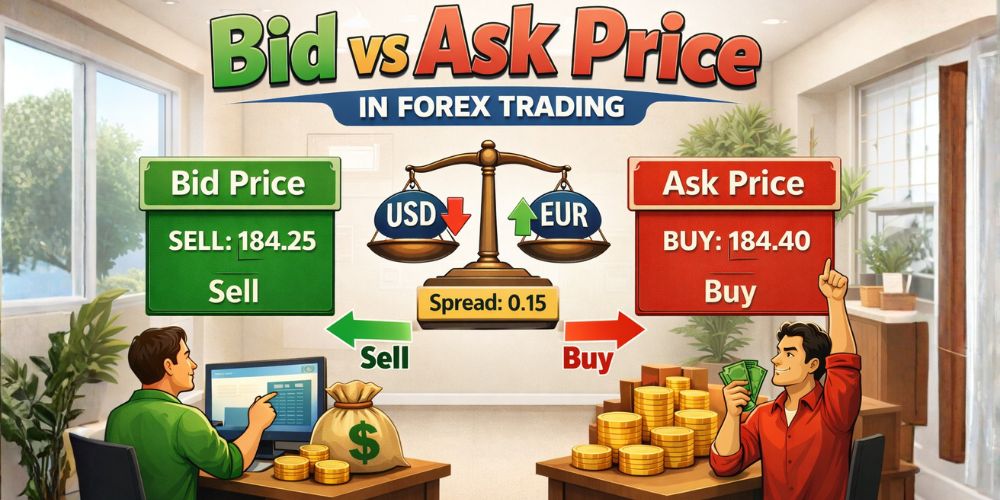
- Bid Price: The price the broker pays you (when you Sell).
- Ask Price: The price you pay the broker (when you Buy).
Spread = Ask Price - Bid Price
Example:
- EUR/USD Bid: 1.0850
- EUR/USD Ask: 1.0852
- Difference: 0.0002 (or 2 Pips)
This means that as soon as you click "Buy," your trade opens with a loss of 2 Pips. The market must move 2 Pips in your favor just for you to break even. This is how "No Commission" brokers make their revenue.
How to Calculate the Cost in Dollars
Knowing the spread is 2 pips is good, but how much is that in money? It depends on your Lot Size.
- Standard Lot (1.00): 1 Pip = $10. Cost of 2 Pip Spread: $20.
- Mini Lot (0.10): 1 Pip = $1. Cost of 2 Pip Spread: $2.
- Micro Lot (0.01): 1 Pip = $0.10. Cost of 2 Pip Spread: $0.20.
Check our live spreads for every asset on the Trading Conditions Page.
2. Fixed vs. Floating Spreads: Which Is Better?
Not all spreads are created equal. Depending on your broker or account type, you might encounter two different structures.
A. Floating (Variable) Spreads
This is the most common model (and what we use at JaazMarkets). The spread changes based on market supply and demand.
- Normal Conditions: The spread is tight (e.g., 1.0 pip).
- Volatile Conditions: During major news (like a US election or NFP release), the spread can "widen" (e.g., jump to 5.0 pips).
- Pros: You get the cheapest possible price most of the time.
- Cons: Costs can be unpredictable during news events.
B. Fixed Spreads
Some brokers offer a spread that never changes, no matter what happens in the market.
- Pros: You always know your cost exactly.
- Cons: The fixed price is usually higher than the average floating price (e.g., it stays at 3.0 pips forever). You pay a premium for stability.
3. The Swap: The Cost of Holding Overnight
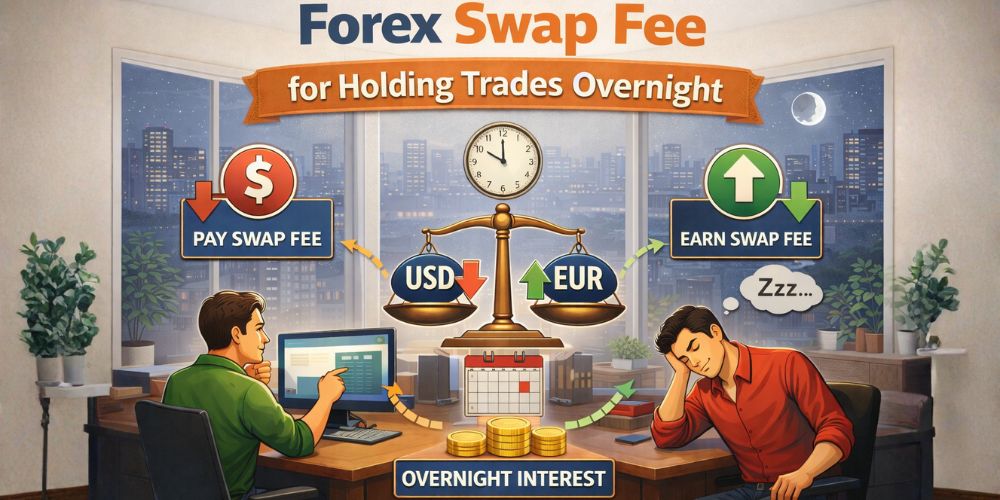
The Spread is the cost to open the trade. The Swap is the cost to keep it open.
Forex trading is effectively borrowing one currency to buy another. Because you are borrowing money, interest rates apply.
- If you hold a trade past 5:00 PM New York Time (the end of the banking day), the broker rolls your position over to the next day.
- This rollover incurs a fee (or a credit) called a Swap.
Can You Earn Money from Swaps?
Yes! This is called the "Positive Carry."
- Scenario: You Buy a currency with a high interest rate (e.g., USD at 5%) and Sell a currency with a low interest rate (e.g., JPY at 0%).
- Result: The broker pays you the difference in interest. You wake up with more money than you went to sleep with.
The Negative Swap
- Scenario: You do the opposite (Buy low interest, Sell high interest).
- Result: You are charged a fee.
Where to find Swap Rates:
You don't need to guess. You can see the exact Swap Long and Swap Short rates for every pair on our Specifications Page or directly inside your trading platform (Right-click a symbol -> Specification).
Pro Tip: Wednesday is "Triple Swap Day." Since banks are closed on weekends, the interest for Saturday and Sunday is applied on Wednesday night. If you hold a trade over Wednesday night, the swap fee is 3x larger!
4. Commissions: The "Raw Spread" Model
Some advanced traders (Scalpers) hate spreads. They want the price to be exactly what the market says, with zero markup. For these traders, brokers offer ECN or Raw Accounts.
- Spread: 0.0 Pips (or extremely low).
- Commission: You pay a flat fee (e.g., $7 per Standard Lot).
Comparison:
- Standard Account: You pay a 1.5 pip spread ($15 cost), but $0 commission. Total = $15.
- Raw Account: You pay 0.0 pip spread ($0 cost), but $7 commission. Total = $7.
Why doesn't everyone use Raw Accounts? Usually, Raw Accounts require a higher minimum deposit. For a beginner with $100, the Standard Account is simpler to manage because the math is easier. Compare our different account structures here: Account Types.
5. Slippage: The "Invisible" Cost
We discussed this briefly in the Order Types guide, but it counts as a cost. Slippage happens when you click "Buy" at 1.1050, but the market is moving so fast that your order gets filled at 1.1052.
- That 2 pip difference is a cost to you.
- Is it a scam? No. It is a natural phenomenon in a digital market. It takes milliseconds for your internet signal to reach the server. In that time, the price can change.
How to avoid it:
- Don't trade during huge news events (volatility causes slippage).
- Use Limit Orders instead of Market Orders (Limit orders guarantee price, but not execution).
Summary Table: Which Cost Affects You?
| Cost Type | When do you pay it? | Who pays it? | How to minimize it? |
|---|---|---|---|
| Spread | Immediately upon entry | Everyone | Trade during high volume sessions (London/NY). |
| Swap | Overnight (5 PM NY Time) | Swing Traders | Close trades before 5 PM if you want to avoid it. |
| Commission | Upon opening/closing | ECN Account Holders | Use a Standard Account if trading small volume. |
| Slippage | During high volatility | News Traders | Use Limit Orders; avoid news spikes. |
Conclusion: Treat Trading Like a Business
If you ran a coffee shop, you would track the cost of beans, milk, and rent. In trading, Spread, Swap, and Commission are your business expenses. Always refer to our Risk Disclosure before starting.
- A "Scalper" (who trades 50 times a day) cares deeply about Spreads.
- A "Swing Trader" (who holds for weeks) cares deeply about Swaps.
To be profitable, your winning trades must be large enough to cover these costs and leave profit on top. This is why trading for 1 or 2 pips is very difficult—the costs eat your margin. Learn more in our Trading Glossary.
- Log in to the Web Trader.
- Right-click on EUR/USD and select Specification.
- Look for "Swap Long" and "Swap Short."
- Calculate: If you bought 1 Lot and held it for a week, how much would it cost (or earn) you?
Understanding these numbers separates the gamblers from the business owners. Are you ready to practice? Start today with a Demo Account. If you have questions, visit our FAQ or Contact Us.