What Is Online Trading? A Beginner's Guide for 2026
Imagine being able to buy a share of Apple, a bar of Gold or exchange US Dollars for Euros all from your smartphone while sitting in a coffee shop. Twenty years ago, this was impossible for the average person. Today, it is a daily reality for millions.
But what exactly is online trading?
Is it the same as gambling?
How does it actually work behind the scenes?
If you are new to the financial markets, this guide is your starting point. In this comprehensive breakdown for 2026, Jaaz Markets explain how online trading works, what you can actually trade, and the first steps to getting started safely.
The Basics: What is Online Trading?
At its simplest level, online trading is the act of buying and selling financial assets through the internet.
In the past, if you wanted to buy stocks or commodities, you had to call a broker on a telephone, who would then physically execute the order on a trading floor. It was slow, expensive and mostly reserved for wealthy individuals.
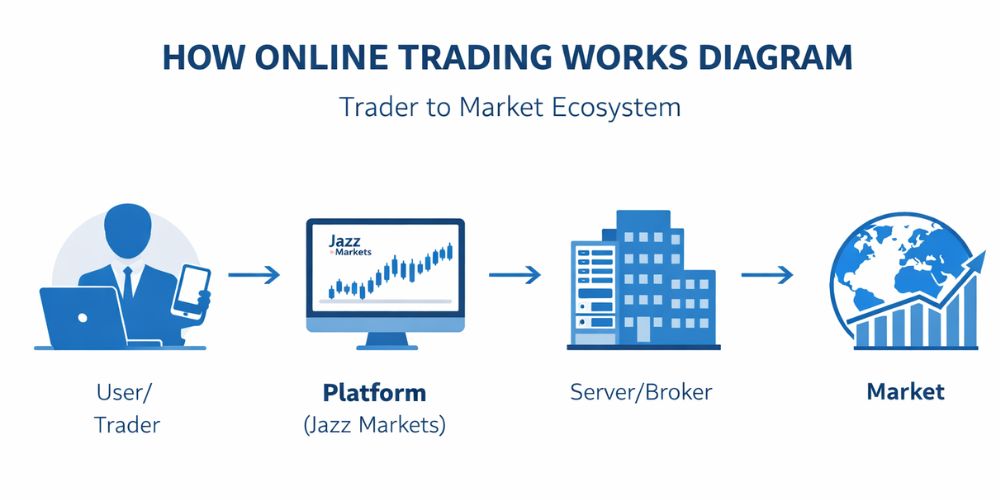
Today, the internet has removed the middleman. You use a Trading Platform - software on your phone or laptop to place orders instantly. When you click "Buy," your order is sent to a broker (like JaazMarkets), who executes it in the global market in milliseconds.
How Does Online Trading Actually Work?
To understand trading, you need to understand the ecosystem. It isn't just you against the market. There is a chain of technology that makes your trade happen.
Here is the step-by-step lifecycle of a trade:
Trading vs. Investing: What is the Difference?
Many beginners use these words interchangeably, but they are very different strategies.
| Feature | Trading | Investing |
|---|---|---|
| Time Horizon | Short-term (Minutes, Hours, Days) |
Long-term (Years, Decades) |
| Goal | Quick profits from price changes |
Long-term wealth accumulation |
| Frequency | High (Multiple trades a day/week) |
Low (Buy and hold) |
| Analysis | Technical Analysis (Charts & Patterns) |
Fundamental Analysis (Company health) |
| Risk | Higher risk, higher potential speed of return |
Lower risk, compound growth |
In short: An investor buys a stock hoping it will grow over 10 years. A trader might buy a currency pair hoping it will rise in the next 10 minutes.
What Can You Trade Online?
One of the biggest benefits of modern online trading is choice. You aren't limited to just one type of asset. Through a single broker, you can access multiple global markets.
Here are the most popular assets for beginners:
-
Forex (Foreign Exchange)
Forex is the exchanging of currencies, such as the Euro against the US Dollar (EUR/USD). It is the largest financial market in the world, operating 24 hours a day during the week.
Why trade it? High liquidity and you can start with small amounts. -
Stocks (Equities)
This involves buying shares of public companies like Tesla, Amazon, or Google.
Why trade it? You can profit from the performance of brands you know and love.
Learn more about our Stock offerings here. -
Commodities
These are physical goods. The most common commodities to trade are Gold, Silver and Oil.
Why trade it? Commodities often move differently than stocks, making them great for diversifying your risk.
Check out our Commodities specifications. -
Indices
Instead of buying one stock, you trade the performance of a whole group. For example, the S&P 500 tracks the top 500 companies in the US. If the US economy does well, the index goes up.
Key Concepts Every Beginner Must Know
Before you place your first trade, you must learn the "language" of trading. If you don't understand these four terms, you are flying blind.
-
The Spread
The spread is the difference between the Buy price (Ask) and the Sell price (Bid).
Example: If the price of Gold is 2000.00 / 2000.50, the spread is 0.50. This is essentially the cost of the trade. You start every trade slightly negative because of the spread. -
Leverage
Leverage allows you to control a large position with a small amount of money.
Example: With 1:100 leverage, you can control $10,000 worth of currency with just $100 in your account.
Warning: Leverage amplifies your profits, but it also amplifies your losses. It is a double-edged sword. -
Margin
Margin is the actual money required in your account to open a leveraged position. It acts as a "security deposit." If your trade starts losing too much money, you may get a "Margin Call," where the broker asks you to deposit more funds or closes your trade to prevent further loss. -
Pips
In Forex, we don't usually count profit in dollars; we count in "Pips" (Percentage in Point). For most currency pairs, a pip is the fourth decimal place.
Example: If EUR/USD moves from 1.1050 to 1.1051, that is a 1 Pip movement.
3 Different Styles of Trading
You don't need to be glued to your screen 24 hours a day to be a trader. Your style depends on your personality and how much time you have.
- Day Trading: You open and close all your trades within one single day. You never hold a trade overnight. This requires focus and quick decision-making.
- Scalping: The fastest style of trading. Scalpers hold trades for seconds or minutes, trying to grab very small profits many times a day.
- Swing Trading: This is popular for people with full-time jobs. Swing traders hold positions for days or weeks, trying to catch a larger market "swing" or trend.
How to Start Trading in 2026 (Step-by-Step)
If you are ready to dip your toes into the market, here is the logical path to follow. Do not skip steps, or you risk losing your capital.
Tip: Look for brokers that offer segregated accounts, meaning your money is kept separate from the company's money.
- Practice opening and closing orders.
- See how leverage affects your balance.
- Test a strategy before using real cash.
The Golden Rule: Risk Management
We cannot end this guide without talking about safety. The harsh reality is that many new traders lose money because they treat trading like a casino.
Trading is not gambling; it is probability management.
- Never risk more than you can afford to lose.
- Use a Stop Loss: A Stop Loss is an automatic order that closes your trade if the price goes against you by a certain amount. It is your safety net.
- Control your emotions: Do not "revenge trade" (trying to win back money immediately after a loss).
Conclusion
Online trading is one of the most exciting skills you can learn in the modern digital economy. It offers freedom, flexibility, and the potential for financial growth. However, it requires discipline, patience, and a willingness to learn.
The markets are waiting. Are you ready to take your first step?