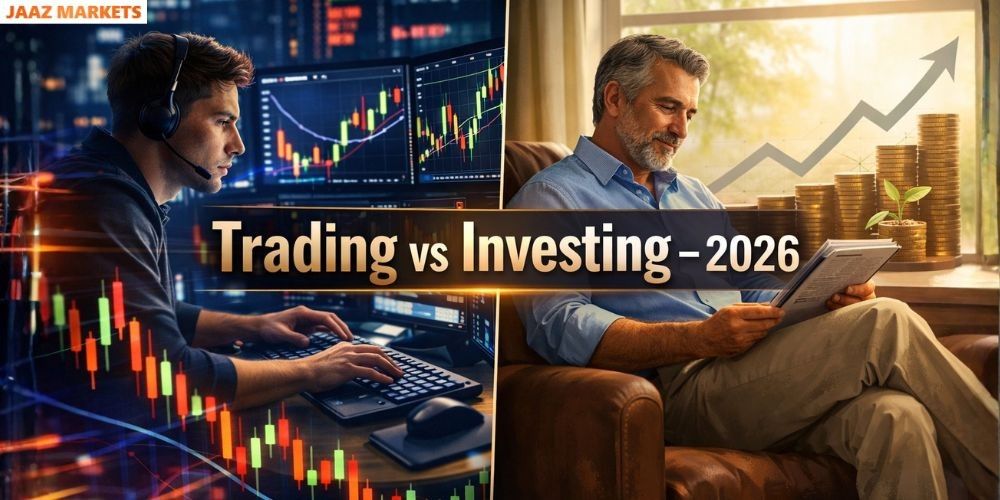
Trading vs. Investing: Which Strategy Is Right for You in 2026?
When you hear "stock market," what do you picture? Do you see a chaotic floor with people shouting "Sell! Sell!"?
Or do you imagine Warren Buffett calmly reading a newspaper and holding a stock for 50 years?
The truth is, both images are correct. They just represent the two different sides of the financial world: Trading and Investing.
Many beginners use these terms interchangeably, but they are completely different "sports" played on the same field.
Confusing them is one of the fastest ways to lose money. For example, applying an investing mindset to a day trade can be disastrous.
In this guide, Jaaz Markets break down the real differences, the pros and cons of each and help you decide which style fits your financial goals in 2026.
The Core Difference: The "Hunter" vs. The "Farmer"
The easiest way to understand the difference is by looking at the goal and the timeline.
Investing is about wealth accumulation over the long term.
- The Goal: To gradually build wealth over years or decades through compound interest, dividends, and asset appreciation.
- The Mindset: "I am buying a piece of a business. I believe this business will be bigger in 10 years than it is today."
- Time Horizon: Years to Decades.
- Example: Buying Apple (AAPL) stock because you think everyone will still be using iPhones in 2030. You don't care if the price drops next week.
Trading is about income generation in the short term.
- The Goal: To generate quick profits by capitalizing on price fluctuations. Traders want to "buy low and sell high" repeatedly.
- The Mindset: "I don't care about the company's 10-year plan. I only care that the price is moving right now."
- Time Horizon: Seconds, Minutes, Days, or Weeks.
- Example: Buying Gold because the price just broke a resistance level on the chart. You plan to sell it in 2 hours for a profit.
Key Differences at a Glance
| Feature | Trading | Investing |
|---|---|---|
| Primary Goal | Short-term Income / Cash Flow | Long-term Growth / Retirement |
| Tools Used | Technical Analysis (Charts) | Fundamental Analysis (Earnings Reports) |
| Risk Level | High (due to frequency & leverage) | Lower (due to time diversification) |
| Involvement | Active (Requires daily/weekly attention) | Passive (Set and forget) |
| Returns | Potential for high monthly % | Aiming for 8-10% annually (Market Avg) |
A Deeper Look: How Traders Analyze the Market
Traders rely heavily on Technical Analysis. They aren't reading the CEO's annual letter. Instead, they are looking at price patterns, volume, and mathematical indicators.
A trader asks:
- "Is the price trending up or down?"
- "Is the market 'overbought' right now?"
- "Where should I put my Stop Loss?"
Traders often use Leverage to amplify small price movements. Since a currency pair like EUR/USD might only move 0.5% in a day, a trader uses leverage to turn that 0.5% movement into a 5% or 10% profit on their account.
A Deeper Look: How Investors Analyze the Market
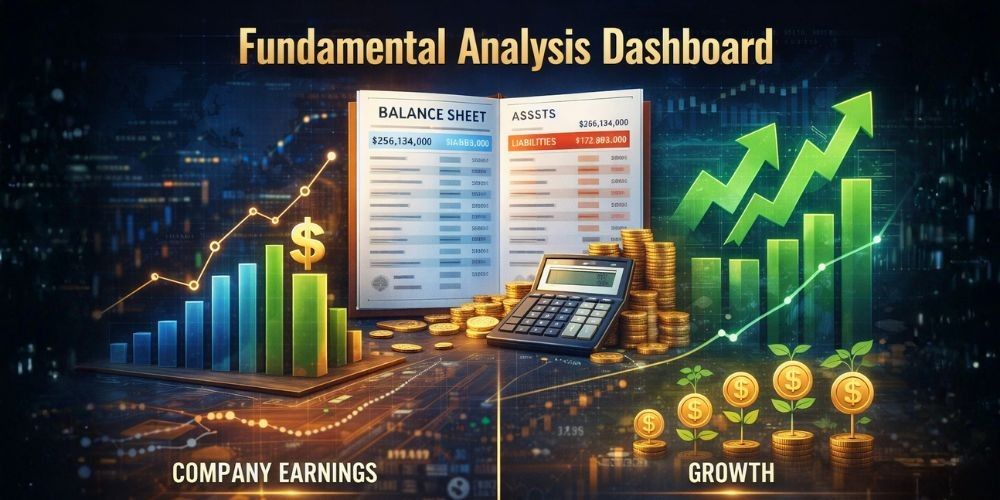
Investors rely on Fundamental Analysis. They look at the "health" of the asset.
An investor asks:
- "Does this company have a lot of debt?"
- "Is their product better than the competition?"
- "Does this stock pay a dividend?"
Investors rarely use leverage. They pay the full price for the asset and hold it. If the market crashes by 20%, an investor doesn't panic—they might even buy more, viewing it as a "discount."
The Pros and Cons
Trading
✅ Pros:
- Quick Returns: You don't have to wait 20 years to see a profit.
- Profit in Any Direction: Traders can "Short Sell," meaning they can make money even when the market is crashing.
- Accessibility: With platforms like JaazMarkets, you can start with small capital.
❌ Cons:
- Higher Risk: You can lose money quickly if you don't manage risk. (View Risk Disclosure)
- Emotional Stress: It requires discipline and focus.
- Learning Curve: You need to learn how to read charts.
Investing
✅ Pros:
- Compound Interest: The magic of time makes money grow exponentially.
- Less Effort: You don't need to check charts every day.
- Lower Stress: Daily market swings don't matter as much.
❌ Cons:
- Slow Growth: It takes years to build significant wealth.
- Market Risk: If the whole economy enters a recession, your portfolio value drops (though usually recovers eventually).
- Capital Heavy: To make $1,000 a month in dividends, you need a huge amount of capital invested.
Which One Is Right for You?
This is the most important question. The answer depends on your Personality, Capital, and Goals.
Choose TRADING if:
- You want to generate active income or cash flow.
- You enjoy analyzing charts, patterns, and psychology.
- You have time to dedicate to learning and monitoring markets (even just 1 hour a day).
- You have a higher risk tolerance.
Choose INVESTING if:
- You want to build a retirement nest egg.
- You want to be "hands-off" and don't want to look at screens.
- You have a low risk tolerance and prefer safety over speed.
Can You Do Both? (The Hybrid Approach)
Here is the secret: Most successful wealthy people do both. They might have an "Investment Portfolio" where 80% of their money sits in safe, long-term stocks or ETFs. Then, they take 20% of their money and put it into a Trading Account to actively trade Forex, Commodities, or Crypto for higher potential returns.
With JaazMarkets, you can actually apply both strategies:
- You can trade Stocks like Apple or Tesla to capture short-term moves.
- You can trade Commodities like Gold as a hedge against inflation.
The Verdict for 2026
In 2026, technology has blurred the lines. You don't need to be a wall street pro to trade, and you don't need to be a millionaire to invest. The most important step is to just start by checking our Academy.
If you are curious about the "Trading" side—the excitement of the markets and the potential for short-term income—the best way to learn is by doing.