
What Is a Pip in Forex? How to Calculate Profit and Loss Correctly
Category: Trading Tools & Calculations | Reading Time: 9 Minutes
In the real world, we measure distance in meters or miles. We measure weight in kilograms or pounds. In the Forex world, we measure price movement in Pips.
If you hear a trader say, "I caught 50 pips on Gold today," or "The spread is 2 pips," and you don't know exactly what that means, you are trading blind. You cannot calculate your risk, your target, or your potential profit without understanding this unit of measurement.
In this guide, we will explain the math behind the Pip. We will show you how to read it on different pairs (especially the tricky Japanese Yen pairs), what a "Pipette" is, and how to instantly calculate how much a pip is worth in actual dollars.
1. The Definition: What Does "PIP" Stand For?
PIP stands for "Percentage in Point" (or sometimes "Price Interest Point"). It represents the standardized unit of change in a currency pair.
Because currencies don't usually move by whole dollars (e.g., Euro moving from $1.00 to $2.00 in a day is impossible), we need a way to measure tiny fluctuations. Review our Trading Glossary for more terms.
The "4th Decimal" Rule
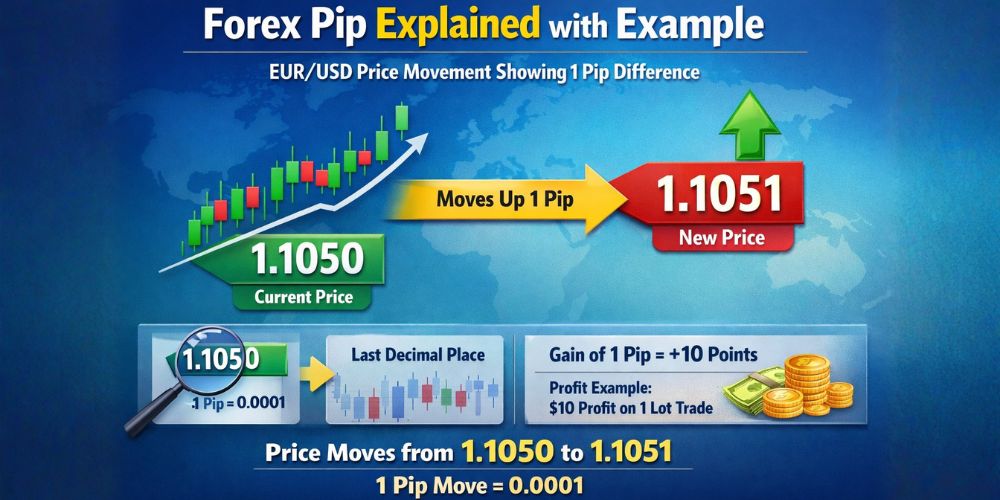
For most major currency pairs (like EUR/USD, GBP/USD, USD/CHF), a Pip is the 4th decimal place.
- Quote A: 1.1050
- Quote B: 1.1051
- Difference: 0.0001
- Result: The price moved 1 Pip.
Example: If you buy EUR/USD at 1.1500 and sell it at 1.1520, you have made a profit of 20 Pips.
2. The Major Exception: Japanese Yen (JPY) Pairs
This is where 90% of beginners get confused. If a currency pair includes the Japanese Yen (e.g., USD/JPY, EUR/JPY, GBP/JPY), the Pip is NOT the 4th decimal place.
Because the Yen is worth much less than a Dollar (it takes ~150 Yen to buy $1), JPY pairs only have two or three decimal places. Check the Contract Specifications for these pairs.
The "2nd Decimal" Rule (for JPY)
For Yen pairs, a Pip is the 2nd decimal place.
- Quote A: 145.50
- Quote B: 145.51
- Difference: 0.01
- Result: The price moved 1 Pip.
Example: If USD/JPY moves from 145.50 to 145.80, it has moved 30 Pips.
3. What is a "Pipette"? (The Fractional Pip)
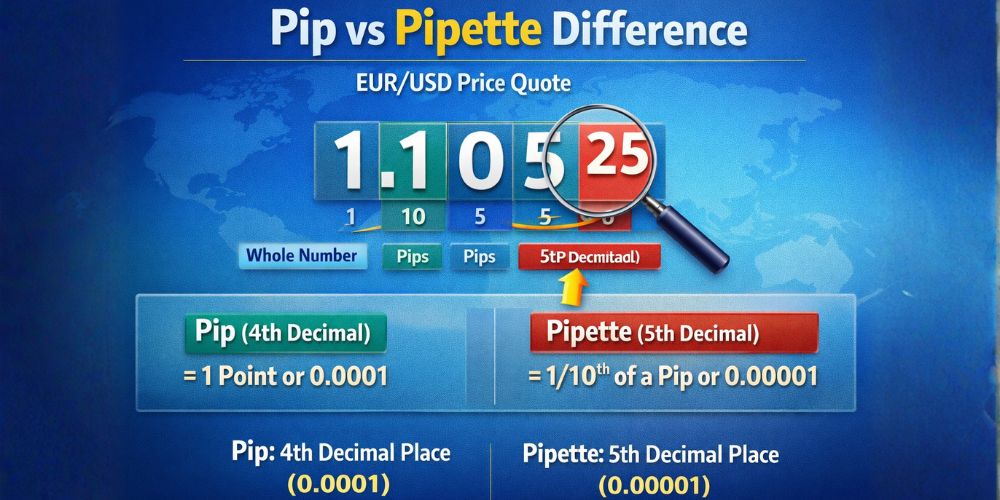
Modern technology has made trading even more precise. Today, most brokers (including JaazMarkets) quote prices to the 5th decimal place (or 3rd for JPY).
This extra tiny number is called a Pipette (or a Fractional Pip). It is 1/10th of a Pip. This feature is available on our Desktop Platform.
How to read it:
- Quote: 1.10525
- The large numbers 1.1052 are the Pips.
- The tiny 5 at the end is the Pipette.
Note: When calculating your profit, you usually ignore the Pipette or round it. We trade for Pips, not Pipettes.
4. How to Calculate the Value of a Pip (The Money Math)
Knowing you made "50 pips" is great, but can you buy dinner with pips? No. You need to know what that is worth in cash. The value of a pip depends entirely on your Lot Size.
Assuming your account is in US Dollars and you are trading a pair where USD is the quote currency (like EUR/USD):
| Lot Size | Volume (Units) | Value per 1 Pip |
|---|---|---|
| Standard Lot (1.00) | 100,000 | $10.00 |
| Mini Lot (0.10) | 10,000 | $1.00 |
| Micro Lot (0.01) | 1,000 | $0.10 (10 cents) |
The Formula: Profit = (Number of Pips) x (Value per Pip)
- Trade: You Buy 1.00 Lot of EUR/USD.
- Movement: Price rises by 50 Pips.
- Calculation: 50 pips x $10 = $500 Profit.
- Trade: You Buy 0.10 Lot of GBP/USD.
- Movement: Price falls by 30 Pips (hits Stop Loss).
- Calculation: 30 pips x $1 = $30 Loss.
5. What If USD Is Not the Quote Currency?
The math gets slightly tricky when USD is not the second currency (e.g., USD/CHF or USD/JPY). The pip value changes slightly based on the exchange rate. You can see live examples on our Web Trader.
- For USD/CAD: A Standard Lot pip might be worth ~$7.50 instead of $10.
- For EUR/GBP: A Standard Lot pip might be worth ~$12.00.
Do you need to do this math manually? Absolutely not. No trader sits with a calculator doing division while the market is moving. 👉 Use our Pip Calculator. The tool will tell you exactly how much each pip is worth right now.
6. Pips in Indices and Gold (XAU/USD)
Be careful! "Pips" are technically a Forex term. When trading commodities or indices, we often use different words like "Points" or "Ticks," but the concept is the same.
Gold (XAU/USD): Gold moves in dollars and cents.
- Price moves from $2000.10 to $2000.20 is a 1 Pip move.
- Standard Lot Value: On Gold, 1 Pip is usually worth $1 (not $10). To make $10, Gold needs to move $1.00 in price (100 pips).
Indices (US30 / NASDAQ): Indices move in "Points." If US30 moves from 34,000 to 34,001, it is 1 Point. The value depends heavily on your contract size. Always check the Trading Conditions.
7. Using Pips for Risk Management
The most important use of pips is not counting profit—it is calculating Risk. Before every trade, you must answer: "How many pips is my Stop Loss?" Learn more about safety in our Security section.
- Analyze Chart: You decide your Stop Loss needs to be 20 pips away from entry.
- Check Budget: You are willing to lose $50 on this trade.
- Calculate Lot Size: $50 (risk) / 20 (pips) = $2.50 per pip.
- Execute: Since a Mini Lot (0.10) is $1/pip, you should trade roughly 0.25 Lots to maintain your risk.
This is how professionals trade. They don't guess; they calculate. Review our Risk Disclosure to understand more.
Conclusion: Master the Math
Understanding Pips is the "literacy" of trading. If you can't read pips, you can't read the market. Practice these skills on our Mobile App while on the go.
- Open your Demo Account or Web Trader.
- Look at USD/JPY. Add 50 pips (Hint: Add 0.50 to the price).
- Look at Gold (XAU/USD). Add 50 pips (Hint: Add $0.50).
Getting comfortable with these small numbers will give you big confidence. If you have questions, visit our FAQ or Contact Us.