Understanding Lot Sizes in Online Trading: A Beginner’s Complete Guide
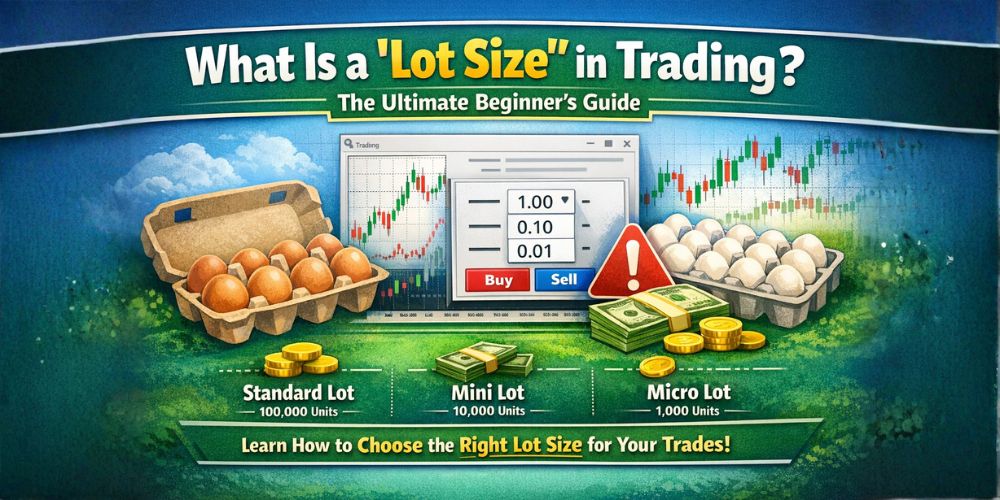
Imagine you walk into a supermarket to buy eggs. You usually cannot buy just one egg. You have to buy a carton of 6, or a carton of 12. In the world of online trading, this "carton" is called a Lot.
When you open your trading platform (like MetaTrader 5) for the first time, you won't see a button that says "Buy $100." Instead, you will see a box asking for a number like 1.00, 0.10, or 0.01. If you enter the wrong number here, you could accidentally risk your entire account in seconds.
In this guide, we will demystify Lot Sizes. We will explain the three main types of lots, how much they are actually worth in dollars, and how to choose the right size for your account balance.
The Definition: What Exactly is a Lot?
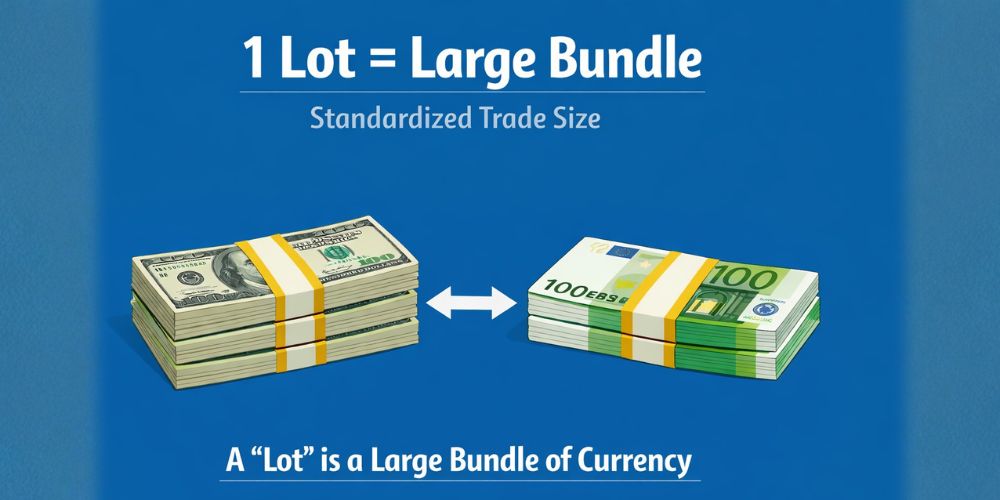
In simple terms, a Lot is a standardized unit of measurement for a transaction. It represents the amount of currency or asset you are buying.
Because currencies (like the US Dollar or Euro) move in tiny fractions, buying just $1 or $10 worth of currency wouldn't make you any profit. To make trading worth it, we trade in large "batches" or "bundles" of currency. These batches are called Lots.
The 3 Key Sizes: Standard, Mini, and Micro
In the old days of banking, you could only trade huge amounts. Today, thanks to modern brokers like JaazMarkets, these sizes have been broken down so anyone can participate. Here are the three sizes you need to memorize:
This is the "Institutional" size.
- Volume: 100,000 units of currency.
- Displayed as: 1.00 in your terminal.
- Value per Pip: Approximately $10 per pip movement.
- Who is it for? Professional traders with large accounts (usually $25,000+).
This is 1/10th of a standard lot.
- Volume: 10,000 units of currency.
- Displayed as: 0.10 in your terminal.
- Value per Pip: Approximately $1 per pip movement.
- Who is it for? Intermediate traders.
This is 1/100th of a standard lot. This is the most common size for beginners.
- Volume: 1,000 units of currency.
- Displayed as: 0.01 in your terminal.
- Value per Pip: Approximately $0.10 (10 cents) per pip movement.
- Who is it for? Beginners with accounts under $1,000.
The "Money Math": How Lot Size Affects Profit & Loss
This is the most important section of this blog. You need to understand the relationship between Lot Size and Pips.
Note: A "Pip" is usually the 4th decimal place in a price. It is the smallest standard move. You can check more terms in our trading glossary.
Let’s look at an example trade on EUR/USD.
- You buy 1.00 Lot of EUR/USD.
- The price moves up by 10 Pips.
- Math: 10 pips x $10 per pip = $100 Profit.
- Risk: If the price went down 10 pips, you would lose $100 instantly.
- You buy 0.01 Lot of EUR/USD.
- The price moves up by 10 Pips.
- Math: 10 pips x $0.10 per pip = $1.00 Profit.
- Risk: If the price went down 10 pips, you would only lose $1.00.
The Lesson: The Lot Size acts as a "Volume Dial" for your risk. If you want to make more money, you turn the dial up (increase lot size). If you want to play it safe, you turn the dial down.
Which Lot Size Should I Use? (The Golden Rule)
New traders often ask: "I have $500 in my account. What lot size should I use?"
The answer depends on your Risk Management. A common rule among professionals is the "1% Rule"—never risk more than 1% of your account on a single trade.
Let’s do the math for a $500 Account:
- Risk Limit: 1% of $500 is $5. You are willing to lose $5 on this trade.
- Stop Loss: Let's say your strategy requires a Stop Loss of 20 Pips.
-
Calculation:
- You can afford to lose $5 over 20 pips.
- $5 ÷ 20 pips = $0.25 per pip.
- Since a 0.01 Micro Lot is $0.10 per pip, you can trade roughly 0.02 Lots.
If you had opened a 0.10 (Mini Lot) on this $500 account, a 20-pip loss would cost you $20 (4% of your account). That is too risky!
Pro Tip: Don't do this math in your head. Use our free Pip Calculator & Position Size Calculator to get the exact numbers instantly.
Does Lot Size Change for Gold or Indices?
Yes! Be very careful here.
The "1 lot = 100,000 units" rule applies mostly to Forex (Currencies). Other assets have different contract sizes.
- Gold (XAU/USD): 1 Standard Lot is usually 100 Ounces of Gold. Check our Metals trading section.
- Silver (XAG/USD): 1 Standard Lot is usually 5,000 Ounces of Silver.
- Indices (US30 / NASDAQ): Contract sizes vary wildly between brokers. See Indices trading details.
Before you trade a new asset (like Oil or Bitcoin), always check the Specifications. If you assume Gold trades the same as Euro, you might accidentally open a position that is 10x bigger than you intended.
3 Beginner Mistakes to Avoid
This is when you accidentally type 1.00 instead of 0.10.
Fix: Always double-check the volume box before clicking Buy or Sell.
High leverage allows you to open huge lot sizes even with a small deposit. Just because the broker allows you to open a 1.00 Standard Lot on a $500 account doesn't mean you should. That is a recipe for a "Margin Call" (blowing your account). Learn more about account security and risk.
Some new traders think trading 0.01 is "boring" because you only make cents. They jump straight to 0.10 or 1.00 to get rich quick.
Reality: If you cannot make a profit on a Micro Lot, you will not make a profit on a Standard Lot. You will just lose money faster. Prove your skill on the small size first.
Conclusion: Start Small, Think Big
Understanding Lot Sizes is the first step to becoming a professional trader. It is the primary tool you have to control your financial destiny.
- 0.01 (Micro) is for learning and practice.
- 0.10 (Mini) is for building income.
- 1.00 (Standard) is for high-volume wealth building (later).
Do not rush the process. The market will always be there.
Your Homework: Open your Demo Account today. Try opening a trade with 0.01, then another with 0.10, and finally one with 1.00. Watch how fast the profit/loss numbers move for each one. Seeing it in action is the best way to learn.