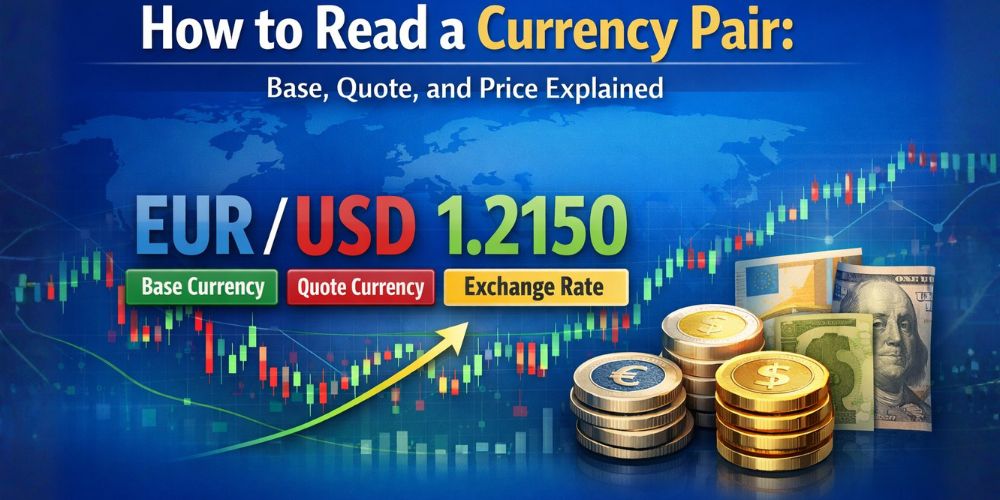
How to Read a Currency Pair: Base, Quote, and Price Explained
In the stock market, things are simple. If you see "Apple: $150," it means one share of Apple costs $150. You pay dollars, you get the stock.
In Forex (Foreign Exchange), things are a bit trickier. You aren't just buying; you are exchanging. You are buying one currency while simultaneously selling another. This is why currencies always come in pairs, like EUR/USD or GBP/JPY.
If you have ever looked at a trading screen and felt confused by the two different prices flashing at you, this guide is for you. By the end of this post, you will be able to read any currency quote like a professional.
1. The Anatomy of a Pair: The "Seesaw"
Every currency pair has a standard structure consisting of three letters on the left and three letters on the right.
Example: EUR / USD
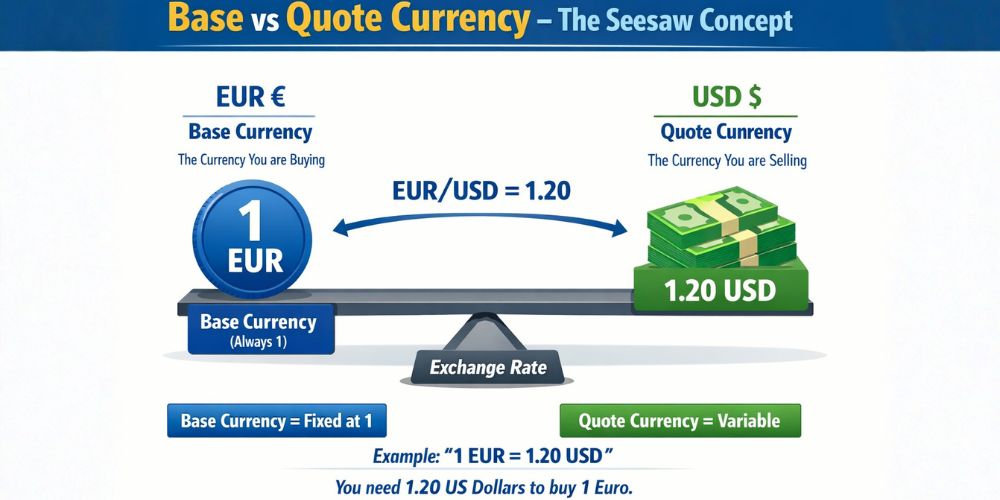
- The First Currency (EUR): This is called the Base Currency.
- The Second Currency (USD): This is called the Quote Currency (or Counter Currency).
The Base Currency is always equal to 1.
When you look at the price, you are asking: "How much of the Quote Currency do I need to pay to buy 1 unit of the Base Currency?"
Real-World Example: If the price of EUR/USD is 1.1000:
- It means 1 Euro is worth 1.10 US Dollars.
- If you have 1 Euro in your pocket, you can swap it for $1.10.
2. Buying vs. Selling (Long vs. Short)
In trading, we don't just "buy." We speculate on the battle between the two currencies. Think of it as a tug-of-war.
You press BUY if you think the Base Currency (the first one) is strong and will go UP in value compared to the Quote currency.
- Scenario: You think the Euro Economy is stronger than the US Economy.
- Action: Buy EUR/USD.
- Result: If the price goes from 1.1000 to 1.1050, you make money because the Euro became more valuable.
You press SELL if you think the Base Currency is weak and will go DOWN.
- Scenario: You think the US Dollar is getting stronger.
- Action: Sell EUR/USD.
- Result: If the price drops from 1.1000 to 1.0950, you make money.
Wait, how can I sell something I don't own? This confuses everyone. In Forex trading, you are not physically handing over cash. You are entering a contract. When you "Sell EUR/USD," you are effectively borrowing Euros to buy Dollars, hoping to buy the Euros back later at a cheaper price. The platform handles all this math instantly in the background.
3. Bid vs. Ask: Why Are There Two Prices?
If you look at your Web Trader, you won't see just one price. You will see two:
EUR/USD: 1.1050 / 1.1052
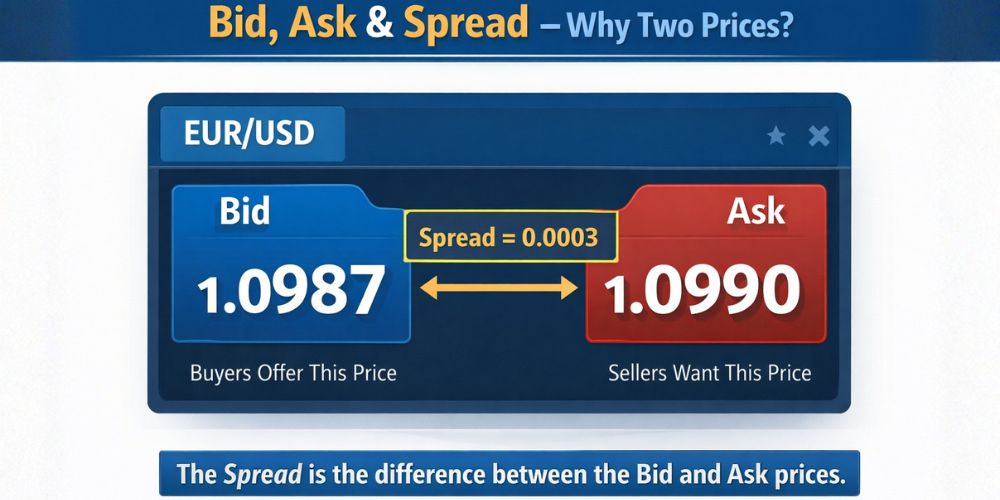
- The First Price (1.1050): This is the Bid.
- This is the price the broker is willing to PAY you.
- This is the price you get if you SELL now.
- The Second Price (1.1052): This is the Ask.
- This is the price the broker ASKS from you.
- This is the price you pay if you BUY now.
Notice the difference? 1.1052 - 1.1050 = 0.0002 (or 2 Pips). This difference is called the Spread. It is the broker's fee.
- When you Buy, you pay the higher price.
- When you Sell, you get the lower price.
- This is why every trade starts slightly negative—you have to cover the spread cost first.
Check our live spreads on the Conditions Page.
4. The Major Pairs: The "Big Dogs" of Trading
There are dozens of pairs you can trade, but they are categorized into three groups. Beginners should stick to the first group.
The Majors (Low Volatility, Low Cost)
These pairs all include the US Dollar (USD) and belong to powerful economies. They have the lowest spreads.
- EUR/USD (Euro / US Dollar) - The most traded pair in the world.
- GBP/USD (British Pound / US Dollar) - Often called "Cable." Moves faster than Euro.
- USD/JPY (US Dollar / Japanese Yen) - Often called "Ninja."
- USD/CHF (US Dollar / Swiss Franc) - Often called "Swissy."
The Minors (Cross Pairs)
These are major currencies that don't include the USD.
- EUR/GBP (Euro / Pound)
- EUR/JPY (Euro / Yen)
- Note: These can be more volatile and have slightly higher spreads.
The Exotics (High Risk)
These pair a major currency with a developing economy's currency.
- USD/MXN (Mexican Peso)
- USD/ZAR (South African Rand)
- Warning: These move wildly and have expensive spreads. Avoid these until you are experienced.
5. How to Calculate Profit (A Quick Example)
Let's put it all together.
The Trade: You decide to buy GBP/USD (Great British Pound vs US Dollar).
- Quote: 1.2500 / 1.2502
- Action: You click BUY. You enter at the "Ask" price: 1.2502.
The Movement: Later that day, good news comes out for the UK economy. The Pound gets stronger.
- New Quote: 1.2550 / 1.2552
The Exit: To close a Buy trade, you must Sell. So, you exit at the new "Bid" price: 1.2550.
Exit Price: 1.2550
Entry Price: 1.2502
Difference: 0.0048
In Forex language, 0.0048 is 48 Pips. If you traded a Standard Lot ($10 per pip), you just made $480. If you traded a Micro Lot ($0.10 per pip), you just made $4.80.
Conclusion: Reading the Story
Learning to read a currency pair is like learning to read music. At first, you just see dots and lines. But soon, you start to hear the melody.
- If EUR/USD is shooting up, it tells you the US Dollar is getting weak (or Euro is strong).
- If USD/JPY is crashing, it tells you investors are scared and running to the "safe haven" of the Yen.
Don't just look at the numbers; look at the story behind them.
- Identify the Bid and Ask price for Gold (XAU/USD).
- Calculate the spread (Ask minus Bid).
- Watch how the numbers change when news happens.