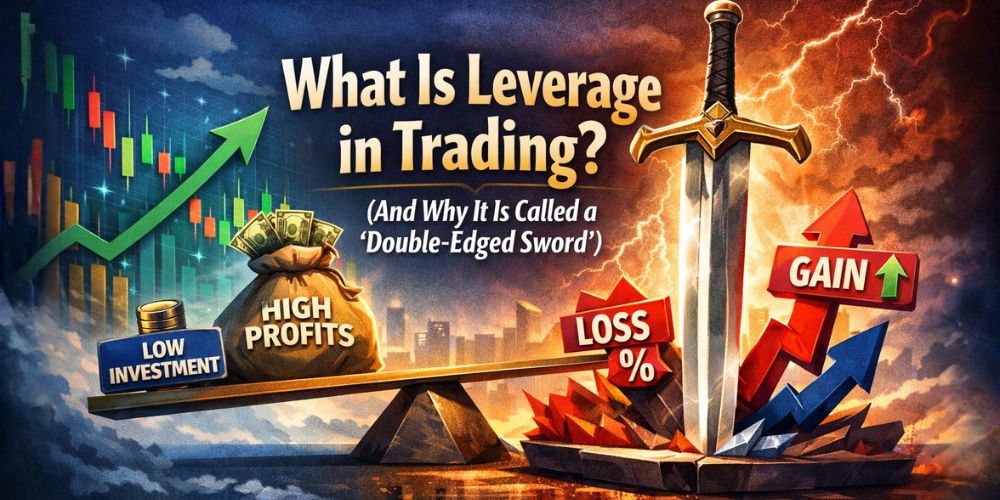
What Is Leverage in Trading? (And Why It Is Called a "Double-Edged Sword")
Imagine you want to buy a house that costs $500,000. Do you need to have $500,000 in cash in your pocket? No. You put down a deposit (say, $50,000), and the bank lends you the rest. You now "control" a $500,000 asset with only $50,000 of your own money.

This is Leverage.
In online trading, leverage works very similarly. It allows traders with small accounts (e.g., $500) to open trades worth much more (e.g., $50,000). It is the only reason retail trading exists. Without it, you would need a millionaire's bank account just to make $10 profit on a currency trade.
However, unlike a house, trading leverage can wipe out your account in minutes if misused. In this guide, we will explain exactly how Leverage and Margin work, the math behind the ratios (1:100 vs 1:500), and how to avoid the dreaded "Margin Call."
The Core Concepts: Leverage vs. Margin
These two terms are two sides of the same coin. You cannot have one without the other.
Leverage is a loan provided by your broker. It is expressed as a ratio, such as 1:100.
- 1:1 means you are trading with only your own cash.
- 1:100 means for every $1 you put up, the broker lets you trade $100.
Margin is the actual money you must lock in your account to open the trade. It is your "Good Faith Deposit."
Think of it this way: Leverage is the ability to buy. Margin is the cost to use that ability.
How It Works: The Math Made Simple
Lets look at a real-world example using Gold (XAU/USD).

Imagine the price of Gold is $2,000 per ounce. You want to buy 10 ounces (which is roughly a 0.10 Mini Lot).
- Total Value of Trade: 10 oz x $2,000 = $20,000.
If you had No Leverage (1:1), you would need $20,000 in your account balance to open this trade. Most beginners don't have that.
Now, let's apply 1:100 Leverage:
- The broker says: "You only need to put up 1% of the trade value."
- Calculation: $20,000 ÷ 100 = $200.
Result: You can control $20,000 worth of Gold with just $200 of your own money (Margin). The remaining $19,800 is "borrowed" from the broker (automatically and instantly).
Check the exact margin requirements for every asset on our Trading Specifications Page.
The "Double-Edged Sword": Why Leverage is Dangerous
This is where beginners get hurt. Leverage amplifies your Profits, but it equally amplifies your Losses.
Lets stick with our Gold example ($20,000 trade value).
- The value of your Gold rises from $20,000 to $20,200.
- Profit: $200.
- Return on Investment: You put in $200 (Margin) and made $200 (Profit). That is a 100% Return on your money in just a few hours!
- Result: You feel like a genius.
- The value of your Gold drops from $20,000 to $19,800.
- Loss: $200.
- Return on Investment: You lost your entire $200 Margin.
- Result: You lost 100% of your investment from a tiny 1% move in the market.
Crucial Lesson: The market only moved 1%, but your account moved 100%. That is the power (and danger) of leverage.
Different Leverage Ratios: Which One is Best?
Brokers offer different leverage settings. At JaazMarkets, you might see options ranging from 1:30 up to 1:500 depending on your region and asset class.
| Leverage Ratio | Margin Required (Deposit) | Risk Level | Best For... |
|---|---|---|---|
| 1:30 | 3.33% | Low | Conservative Investors, Stocks |
| 1:100 | 1% | Medium | Standard Forex Trading |
| 1:500 | 0.2% | High | Scalpers, Small Accounts |
Myth Buster: "Higher leverage means I make more money."
Truth: No. Higher leverage just means you have less margin required. It gives you the ability to open massive trades that can destroy you. Professional traders often use lower leverage to force themselves to be disciplined.
The Nightmare: What is a "Margin Call"?
You might have heard this term in movies. In the digital age, a broker doesn't call you on the phone. The system handles it automatically. There are two stages to running out of money:
This happens when your Equity (Balance Open Profit/Loss) falls below a certain percentage of your Used Margin (e.g., 100%).
- Meaning: "Hey, you are running low on funds to support these losing trades. Please deposit more money or close some positions."
- The platform might turn your balance bar Red.
This is the final safety mechanism. If the market keeps going against you and your Equity falls to a critical level (e.g., 50% or 30% Margin Level), the broker automatically closes your trades.
- Why? To prevent your balance from going negative. The broker is closing the trade to pay back the "loan" before you lose money you don't have.
It is vital to understand our Risk Disclosure regarding Stop Outs and trading conditions.
How to use Leverage Safely (3 Rules)
You don't have to be afraid of leverage, but you must respect it. Here is how professional traders handle it:
- Rule 1: Don't Max Out Your Margin - Just because you can buy 10 lots doesn't mean you should. Keep your "Margin Level" above 500%. If it drops near 100%, you are over-leveraged.
- Rule 2: Use Stop Losses - Never trade on high leverage without a Stop Loss. A Stop Loss caps your downside so you never reach the "Margin Call" level.
- Rule 3: Use the Calculator - Don't guess. Before you open a trade, calculate exactly how much margin it will use. Use our Margin Calculator to test different scenarios before risking real money.
Conclusion: Leverage is a Tool, Not a Gift
Think of leverage like a chainsaw.
- In the hands of a skilled lumberjack, it cuts trees efficiently (Builds Wealth).
- In the hands of a child, it causes injury blows accounts.
If you are a beginner, start with lower leverage (like 1:50 or 1:100). As you become profitable and consistent, you can adjust your account type settings.
Go to your Demo Account. Open a trade with the maximum possible leverage and watch how wildly the numbers swing. Then, open the same trade with small leverage. Feel the difference in your stress levels. That is the best lesson you will ever learn.
Ready to start? Explore our Trading Platforms, read the latest Market News, or check our FAQ if you have more questions. Our support team is always here to help.