What Is Spread in Forex Trading? The "Hidden" Cost Explained (2026)
Category: Trading Tools & Calculations / Costs
Have you ever opened a trade and noticed that you are immediately losing money? You click "Buy," and before the chart even moves, your profit says -$2.00 or -$10.00. You might panic and think, "Did I make a mistake? Is the broker cheating me?"
Relax. This is not a mistake. This is the Spread.
In the world of Forex, nothing is free. While you might not pay a "ticket fee" to enter the market, you pay a difference between the buying price and the selling price. If you don't understand this gap, it can silently eat away at your profits—especially if you are a Day Trader or Scalper.
In this guide, we will break down exactly what the Spread is, how to calculate it in pips and dollars, and why it changes size during the day.
1. The Definition: Bid vs. Ask
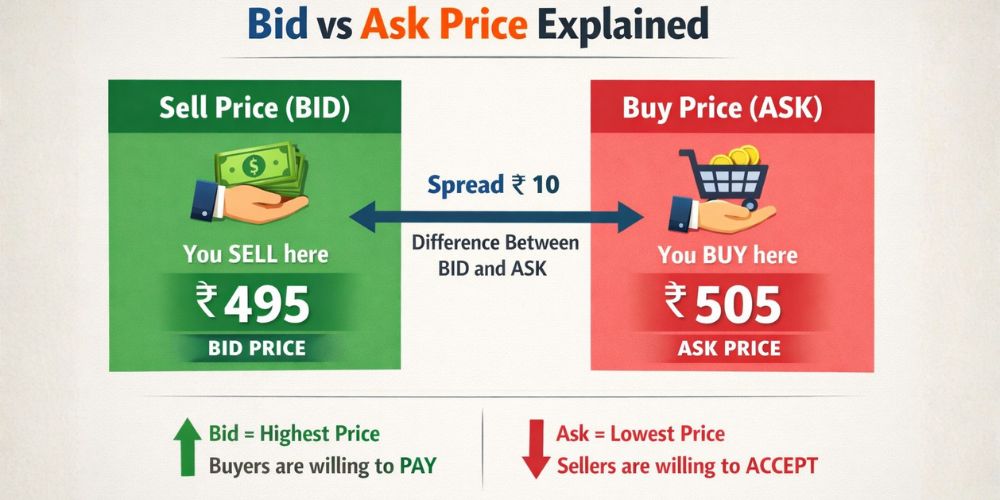
In every financial market, there are always two prices for an asset at any given second.
- The Bid Price: The price the broker is willing to PAY you (if you sell). Think: "The highest price a buyer will offer."
- The Ask Price: The price the broker ASKS from you (if you buy). Think: "The lowest price a seller will accept."
The Spread is simply the gap between these two numbers.
Formula:
Spread = Ask Price - Bid Price
Real-World Analogy:
Imagine you go to a car dealership. The dealer will sell you a car for $20,000 (Ask Price). If you turn around and sell it back to him immediately, he will only give you $19,000 (Bid Price). The $1,000 difference is the dealer's profit (The Spread).
2. How to Calculate the Spread in Pips
Let’s look at a real Forex example using EUR/USD.
- Ask Price: 1.1052
- Bid Price: 1.1050
Calculation:
1.1052 - 1.1050 = 0.0002
In Forex language, the 4th decimal place is a Pip. So, the spread here is 2 Pips. This means the market must move 2 Pips in your favor just for you to break even. Until then, you are technically in debt to the broker.
3. The Money Math: How Much Does It Actually Cost?
Knowing the spread is "2 Pips" is useful, but how much is that in cash? It depends entirely on your Lot Size (Volume).
Here is the cost of a 2 Pip Spread on EUR/USD:
| Lot Size | Volume (Units) | Cost of Spread |
|---|---|---|
| Standard Lot (1.00) | 100,000 | $20.00 |
| Mini Lot (0.10) | 10,000 | $2.00 |
| Micro Lot (0.01) | 1,000 | $0.20 |
4. Fixed vs. Variable Spreads: Which Is Better?
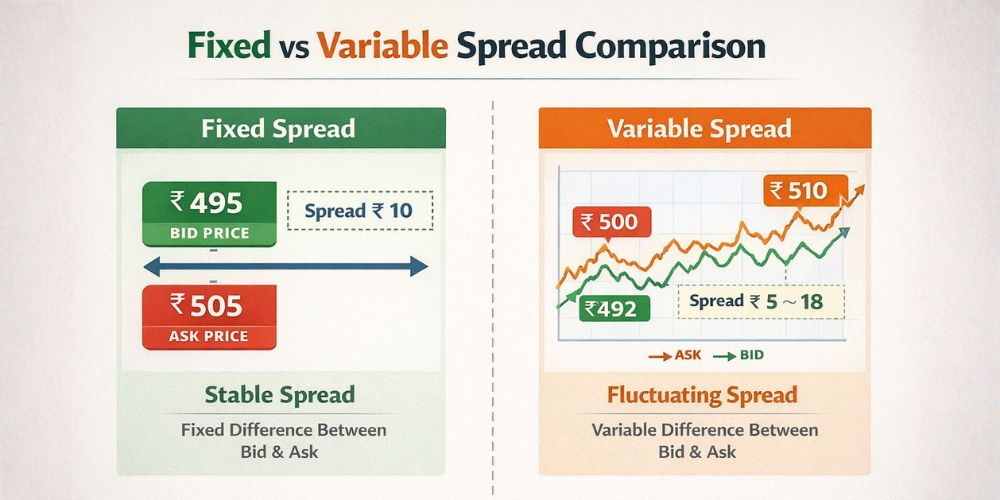
Brokers generally offer two types of spread models. Understanding the difference can save you money.
A. Fixed Spreads
The broker guarantees the spread will stay the same (e.g., 2 Pips) no matter what happens in the market.
- Pros: Predictable. You know exactly what you will pay.
- Cons: Usually more expensive on average. You pay a premium for that stability.
- Best For: News traders and beginners who want simple math.
B. Variable (Floating) Spreads
The spread changes based on supply and demand.
- Pros: Usually cheaper. During active sessions (like London), the spread on EUR/USD can drop to 0.1 or 0.5 pips.
- Cons: It can widen unpredictably during volatile events.
- Best For: Day traders and Scalpers who want the lowest cost.
At JaazMarkets, we offer competitive Variable Spreads to ensure you get the true market price.
5. Why Do Spreads Widen? (The Danger Zones)
Have you ever seen the spread jump from 1 pip to 20 pips in a second? This is called Spread Widening, and it can trigger your Stop Loss if you aren't careful.
It happens for two main reasons:
1. Low Liquidity (The "Dead Zones")
When there are few buyers and sellers, brokers increase the spread to cover their risk.
- When: The "Rollover" period (5:00 PM - 6:00 PM New York Time) or holidays.
- Result: Spreads can double or triple during these times.
2. High Volatility (The "News Event")
When major news breaks (like US Inflation Data or Non-Farm Payrolls), the market becomes chaotic. Banks pull their orders, and the difference between buyers and sellers widens massively.
- When: Economic Calendar releases.
- Result: A spread can jump 10x in milliseconds.
Conclusion: Don't Let the Spread Eat Your Profit
The Spread is not a scam; it is the price of liquidity.
- If you are a Long-Term Trader: You don't need to worry much. Paying 2 pips on a trade where you aim to make 200 pips is irrelevant.
- If you are a Day Trader: You must watch the spread like a hawk. Paying 2 pips when you only aim to make 5 pips eats 40% of your profit!
Checklist for success:
- Trade during the London/New York Overlap for the tightest spreads. Check Trading Hours.
- Avoid trading during the Rollover hour (5 PM NY).
- Check the spread on our Conditions Page before you click Buy.
Ready to see it live?
Open your Demo Account. Watch the Bid and Ask prices on the screen. See how they dance? That is the heartbeat of the market. You can also explore our Web Trader or Mobile App for real-time data.
👉 Start Learning more at our Academy or contact us via our Contact Page if you have questions.