What Is Margin in Trading? A Beginner-Friendly Guide (2026)
Category: Trading Tools & Calculations / Risk Management
If you look at your trading dashboard, you will see a box labeled Margin. Sometimes it says $50.00. Sometimes it says $200.00. New traders often ask:
- "Is this a fee?"
- "Did the broker take this money from me?"
- "Why can't I use this money?"
The answer is: No, it is not a fee. It is a security deposit. Understanding Margin is the key to understanding how much "buying power" you actually have. If you don't understand it, you will likely open a trade that is too big for your account, leading to an instant disaster. In this guide, we will demystify Margin. We will explain the difference between Used Margin and Free Margin, how it relates to Leverage, and how to calculate exactly how much you need before you click "Buy."
1. The Simple Definition: The "Security Deposit"
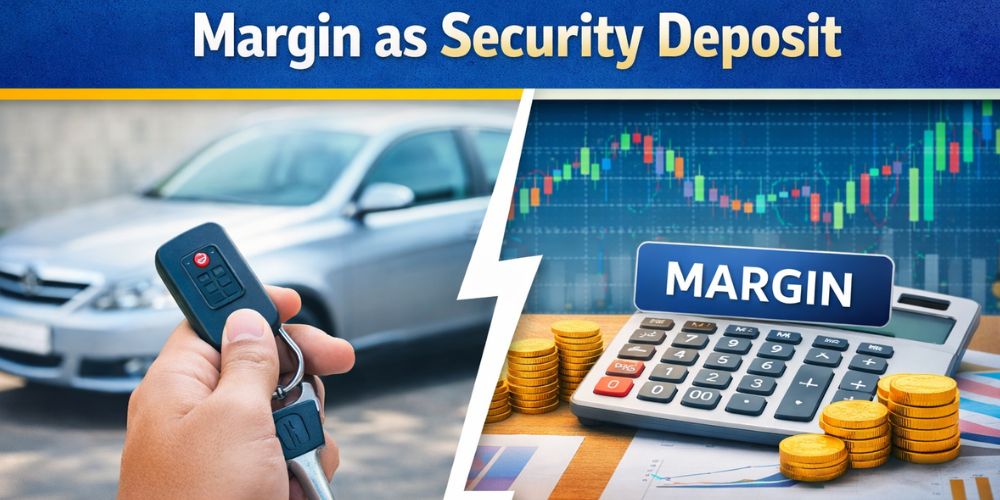
In the real world, if you want to rent a fancy car for the weekend, the rental company will ask for two things:
- The Rental Fee: The cost to use the car (Like the Spread/Commission).
- The Security Deposit: A chunk of money locked on your credit card just in case you damage the car.
Margin is that Security Deposit. When you open a leveraged trade (e.g., buying $100,000 worth of Euro), the broker needs to trust that you can pay for any potential losses. So, they take a small portion of your account balance and "lock" it.
- While the trade is open: You cannot touch or withdraw this money.
- When the trade is closed: The money is "unlocked" and returns to your balance (plus or minus your profit/loss).
Key Takeaway: Margin is not a cost. It is Collateral.
2. The Math: Margin vs. Leverage
Margin and Leverage are two sides of the same coin. You cannot have one without the other.
- Leverage is the power to trade big.
- Margin is the cost to use that power.
Margin Required = Total Trade Value ÷ Leverage Ratio
Real-World Example: Buying EUR/USD
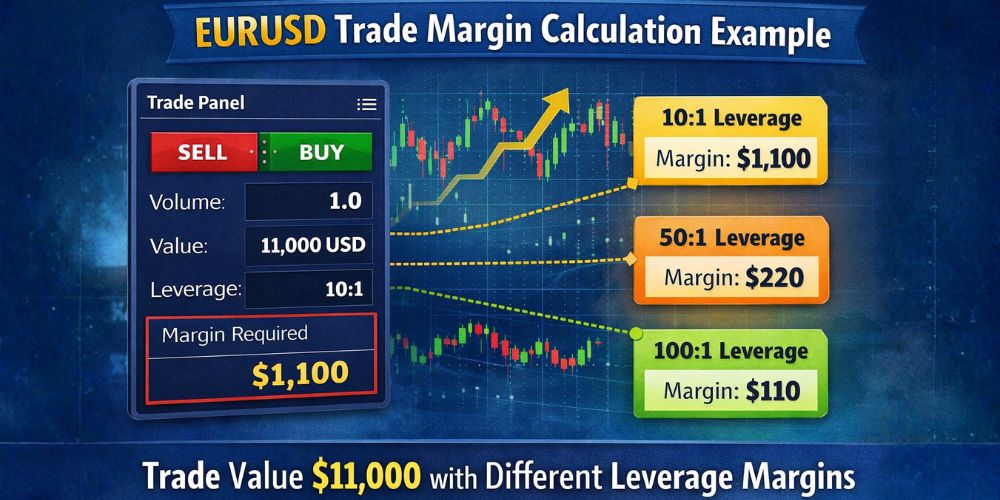
Let’s say you want to buy 1 Mini Lot (0.10) of EUR/USD.
- Trade Value: 10,000 Euros (approx. $11,000 USD).
| Your Leverage | Trade Value | Calculation | Margin Required (Deposit) |
|---|---|---|---|
| 1:1 (None) | $11,000 | $11,000 ÷ 1 | $11,000 |
| 1:50 | $11,000 | $11,000 ÷ 50 | $220 |
| 1:100 | $11,000 | $11,000 ÷ 100 | $110 |
| 1:500 | $11,000 | $11,000 ÷ 500 | $22 |
See the pattern? Higher Leverage = Lower Margin Required. This is why high leverage is popular for small accounts. It allows you to open that $11,000 trade with just a $22 deposit. But remember: Just because the deposit is small doesn't mean the risk is small. You are still trading $11,000 worth of currency!
3. The Terms: Used vs. Free Margin
When you open your Web Trader, you will see two different "Margin" numbers. Confusing them is dangerous.
A. Used Margin (or just "Margin")
This is the Locked money. Think of this as money "in the cage." It is busy supporting your open trades. You cannot use it to open new trades.
B. Free Margin
This is the Available money. Formula: Equity - Used Margin = Free Margin. Think of this as your "Spending Power." This money has two jobs:
- It is available to open new positions.
- It is available to absorb losses from your current positions.
Crucial Warning: If your Free Margin hits $0.00, you are "maxed out." You cannot open any more trades, no matter how good the opportunity looks.
4. The Health Meter: Margin Level %
We discussed this in our Balance vs Equity guide, but it is worth repeating because it is the most important metric for survival.
Margin Level = (Equity ÷ Used Margin) x 100
This percentage tells you how close you are to death (Stop Out).
- 2,000% + : Ultra Safe. You are barely using any of your account.
- 500% : Healthy. Standard professional level.
- 100% : The Danger Zone. This means your Equity is equal to your Used Margin. You have Zero Free Margin.
- 50% (or 30%) : The Kill Zone. This is the "Stop Out Level." The broker will automatically close your trades to prevent your balance from going negative.
5. Margin on Different Assets (Gold vs. Forex)
Beginners often get surprised when they switch from trading Euro to trading Bitcoin or Gold.
"I could open 1 Lot of Euro with $100 margin. Why can't I open 1 Lot of Bitcoin?"
Different assets have different margin requirements because they have different volatility.
- Forex (Major Pairs): Usually requires very low margin (e.g., 1%).
- Gold / Metals: usually requires higher margin (e.g., 5% or 10%).
- Crypto: Requires very high margin (often 20% or 50%) because it crashes often.
Before you trade a new asset class, check the Specifications Page. Don't assume the margin rules are the same for everything.
6. What is a "Margin Call"?
In the old days, a broker would literally call you on the telephone: "Mr. Smith, your trades are losing too much money. Your deposit is no longer enough to cover the risk. Please wire us more money immediately, or we will sell your stocks."
Today, there is no phone call. A Margin Call is a digital alert (usually your dashboard turning red) telling you that your Margin Level has dropped to a dangerous level (usually 100%). You have two choices:
- Deposit more funds: This increases your Equity and boosts your Margin Level back up.
- Close some trades: This releases "Used Margin" back into "Free Margin," increasing your health.
- Do nothing: Pray the market turns around (Not recommended!). If it keeps dropping, you hit the Stop Out.
7. How to manage Margin like a Pro
You don't want to be staring at your Margin Level sweating. You want to trade with peace of mind. Here is the checklist:
Rule #1: The "Smart Leverage" Rule
Just because the broker offers 1:500 leverage doesn't mean you must use it all. If you have $1,000, don't open $500,000 worth of trades. That is suicide. Stick to a real leverage of roughly 1:10 or 1:20 (Total Trade Value vs Account Balance).
Rule #2: Watch the Free Margin
Never let your Free Margin get near zero. Always keep a "buffer." If you have $1,000, try not to use more than $200 as Used Margin. Keep $800 free to handle the market's ups and downs.
Rule #3: Calculate BEFORE You Click
Don't open the trade and then look at the margin. Use the Calculator. Input: EUR/USD, 1 Lot, 1:100 Leverage. Result: Required Margin = $1,100. Ask yourself: "Do I have enough Free Margin for this?"
Conclusion: Margin Is Your Seatbelt
Trading without understanding Margin is like driving without knowing how much gas is in the tank. Eventually, you will get stranded. Always read our Risk Disclosure to understand the dangers of high leverage.
- Margin is the deposit.
- Free Margin is the breathing room.
- Margin Level is the safety score.
Keep your Margin Level high, your Used Margin low, and you will never have to worry about the dreaded Margin Call. Ready to test the math? Open your Demo Account today. For more terms, visit our Trading Glossary.
- Open a 0.01 Lot trade. Note the Used Margin.
- Open a 0.10 Lot trade. Note how the Used Margin jumps x10.
- Watch your Margin Level % drop.
Seeing this relationship live is the best way to learn. If you need help, feel free to Contact Us or check our FAQ.